GSLSimplexMinimizer< dim > Class Template Reference#
|
DiFfRG
Discretization Framework for functional Renormalization Group flows
|
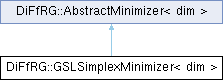
Minimizer using the Nelder-Mead simplex algorithm from GSL. More...
#include <minimization.hh>
Public Member Functions | |
| GSLSimplexMinimizer (const FUN &f, const double abs_tol=1e-4, const int max_iter=1000) | |
| Construct a new GSLSimplexMinimizer object. | |
| void | set_step_size (const double step_size) |
| Set the initial step size for the minimization. | |
| void | set_x0 (const std::array< double, dim > &x0) |
| Set the initial guess for the minimization. | |
| void | set_f_target (const double f_target) |
| Stop as soon as the objective falls to or below this value. | |
| double | get_min_value () const |
| Objective value at the point returned by minimize(). NaN before it ran. | |
| bool | converged () const |
| Whether the search met its criterion: the f-target if one was set, otherwise the simplex-size test. False when it stopped because the simplex collapsed short of the target or the iteration cap was hit – in both cases minimize() still returns the best point found. | |
| const std::string & | get_stop_reason () const |
| Why the search stopped, for logging. | |
 Public Member Functions inherited from DiFfRG::AbstractMinimizer< dim > Public Member Functions inherited from DiFfRG::AbstractMinimizer< dim > | |
| AbstractMinimizer (const FUN &f, const double abs_tol=1e-4, const int max_iter=1000) | |
| Construct a new AbstractMinimizer object. | |
| void | set_abs_tol (const double abs_tol) |
| Set the absolute tolerance for the minimization. | |
| void | set_max_iter (const uint max_iter) |
| Set the maximum number of iterations. | |
| uint | get_iter () const |
| Get the number of iterations used in the last minimization. | |
| std::array< double, dim > | minimize () |
| Perform the minimization. | |
Static Public Member Functions | |
| static double | gsl_wrap (const gsl_vector *v, void *params) |
Protected Member Functions | |
| virtual std::array< double, dim > | minimize_impl () override |
| Protected Member Functions inherited from DiFfRG::AbstractMinimizer< dim > | |
Protected Attributes | |
| std::array< double, dim > | x0 |
| double | step_size |
| double | f_target = std::numeric_limits<double>::quiet_NaN() |
| double | min_value = std::numeric_limits<double>::quiet_NaN() |
| bool | m_converged = false |
| std::string | stop_reason |
| Protected Attributes inherited from DiFfRG::AbstractMinimizer< dim > | |
| FUN | f |
| double | abs_tol |
| uint | max_iter |
| uint | iter |
Private Types | |
| using | FUN = AbstractMinimizer<dim>::FUN |
Additional Inherited Members | |
| Protected Types inherited from DiFfRG::AbstractMinimizer< dim > | |
| using | FUN = std::function<double(const std::array<double, dim> &)> |
Detailed Description
class DiFfRG::GSLSimplexMinimizer< dim >
Minimizer using the Nelder-Mead simplex algorithm from GSL.
- Template Parameters
-
dim Dimension of the minimization problem.
Member Typedef Documentation
◆ FUN
|
private |
Constructor & Destructor Documentation
◆ GSLSimplexMinimizer()
|
inline |
Construct a new GSLSimplexMinimizer object.
- Parameters
-
f Objective function to minimize. Must take a std::array<double, dim> as input and return a double. abs_tol Absolute tolerance for the minimization. max_iter Maximum number of iterations.
Member Function Documentation
◆ converged()
|
inline |
Whether the search met its criterion: the f-target if one was set, otherwise the simplex-size test. False when it stopped because the simplex collapsed short of the target or the iteration cap was hit – in both cases minimize() still returns the best point found.
◆ get_min_value()
|
inline |
Objective value at the point returned by minimize(). NaN before it ran.
◆ get_stop_reason()
|
inline |
Why the search stopped, for logging.
◆ gsl_wrap()
|
inlinestatic |
◆ minimize_impl()
|
inlineoverrideprotectedvirtual |
Implements DiFfRG::AbstractMinimizer< dim >.
◆ set_f_target()
|
inline |
Stop as soon as the objective falls to or below this value.
The simplex-size test alone answers "has the search stopped moving", which is a statement about the parameter space and says nothing about whether the answer is any good. When the objective is a calibrated quantity – an RMS residual, say – a target on IT is the meaningful criterion, and the size test degrades to a give-up condition. NaN (the default) disables this and restores pure size-based convergence.
◆ set_step_size()
|
inline |
Set the initial step size for the minimization.
- Parameters
-
step_size Initial step size.
◆ set_x0()
|
inline |
Set the initial guess for the minimization.
- Parameters
-
x0 Initial guess.
Member Data Documentation
◆ f_target
|
protected |
◆ m_converged
|
protected |
◆ min_value
|
protected |
◆ step_size
|
protected |
◆ stop_reason
|
protected |
◆ x0
|
protected |
The documentation for this class was generated from the following file:
- /home/runner/work/DiFfRG_current/DiFfRG_current/DiFfRG/include/DiFfRG/common/minimization.hh
Generated by
 1.12.0